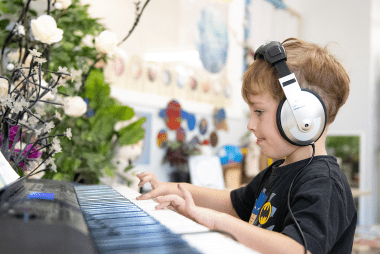
Did you know that music is one of the few activities that uses both the logical and creative sides of the brain? The benefits of music in early childhood have been widely explored, with one study by the Brain and Creativity Institute finding that musical experiences in childhood can accelerate the development of children’s brains in processing sound, language, speech perception and even reading skills.
Music and movement come naturally to children of all ages. Even the youngest infants will bounce, sway, smile or wave their hands to their favourite tunes. It’s common for preschool-aged children to make up their own songs and rhymes or sing to themselves during play. Music-making is a natural part of early education that ignites all areas of cognitive development, including literacy and numeracy skills, emotional intelligence and socialising as part of a group.
Music in the Early Years
According to Early Childhood Australia, exposing children to music in the early years has many benefits for child development. Learning to understand music engages children and toddlers in ways that help build critical skills for later in life.
Music benefits for toddlers
Music benefits toddlers by developing their physical and cognitive skills, encouraging them to interact with and recognise language, social cues and sounds. Songs, rhymes, movement and simple instruments are fun ways of developing these skills in young children.
Here are a few benefits of music for toddlers:
- Listening and memory: Songs and rhymes encourage toddlers to listen closely and remember words, actions or patterns to anticipate what comes next.
- Speech recognition: Toddlers build their vocabulary and pronunciation skills by hearing and reproducing different sounds or words they hear in music.
- Motor development: Through moving, clapping, dancing, tapping and playing instruments, toddlers develop both fine and gross motor skills.
- Creativity and sensory exploration: Music encourages toddlers to experiment with different sounds, movements and rhythms.
- Social interaction: Group activities involving music help toddlers practice taking turns, sharing instruments and playing alongside their peers.
Music benefits for children
For older children, music can build on earlier skills and help prepare them for school by strengthening listening, language and creative thinking skills.
- Early literacy development: Through music, children learn to recognise rhyming words, build vocabulary and develop clarity in their speech.
- Listening and remembering information: Songs and rhymes encourage children to listen, follow sequences and remember information.
- Numeracy: Beats, rhythm, patterns and tempo introduce children to counting and keeping a steady beat.
- Confidence and self-expression: As children learn songs and perform actions, they develop the confidence to communicate and express themselves in group activities and classroom activities.
- Composition: Music in early childhood can pave the way for a lifelong love of performing and creating music.
Supporting Your Child’s Musical Development at Home
There are so many ways to incorporate music and movement into your child’s play. You don’t need to be a musician or have any special skills or equipment on hand. Being musical with your child can be as simple as clapping a beat, singing a nursery rhyme or even turning on the radio and moving to your favourite songs!
Create home-made instruments
Early Childhood QLD has some great suggestions for making simple instruments at home. You could fill a water bottle with rice or buttons to make a shaker, make clap sticks out of chopsticks or dowelling, or fashion a drum set out of different-sized pots and pans. As children shake, tap or hit their instruments, they explore loud and soft sounds, practice coordination and begin to recognise rhythm.
Communicate through song
Use rhymes and songs to communicate with your child. Incorporating songs into daily routines can be especially comforting for infants. You could sing a short song about bath time, say a nursery rhyme during nappy change time or play quiet, peaceful music to soothe them at bedtime.
Dance to music
Get moving to your favourite tunes. Dancing along to music is a fun way to move our bodies that can instantly put a smile on both your and your child’s faces, as well as get some active minutes into the day. Dancing helps children explore how their bodies move, develop coordination and get exercise, all in a fun, positive way.
Remember that children are experts at play, so when it comes to music, we only need to sing and do. No explanations required!
Need ideas for supporting your child’s learning at home?
Ask your child’s educator about UP at Home. Our home learning program has many fun and educational activities that are easy to engage your child with regularly.
Music at Busy Bees
At Busy Bees, we fully believe in the benefits of music for toddlers and preschool-aged children. It provides wonderful opportunities for movement, creativity, language, expression and connections. Our skilled educators incorporate music and movement into our educational programs in many different ways, including:
- Having a variety of musical toys and instruments available to children to explore at any time
- Incorporating songs and rhymes into games and daily activities
- Introducing children to different kinds of music from varied backgrounds and genres
- Educators with special skills in music will play instruments for children and share their knowledge
- Engaging in movement games such as dancing and yoga
- Having musically-inclined parents and teachers visit our childcare locations to share their talents with the children
- The Busy Bees Unleashing Potential (UP) App also has a music and nursery rhyme function to assist Educators to deliver musical experiences to children
Get Started with Busy Bees Today
Music has benefits for toddlers, preschoolers and infants. It plays a vital role in helping children build confidence with movement, language and social interaction. It supports the development of listening, literacy, numeracy and self-expression skills that prepare them for school.
At Busy Bees, music is woven into our educational programs to support creativity, connection, movement and joyful learning every day. Contact us today to learn more about how we impart the benefits of music in early childhood through fun, supervised play.