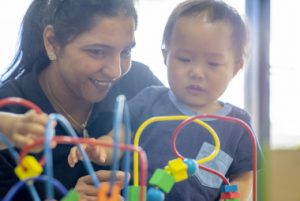
Group interaction can be incredibly important in the early years of a child’s life. Learning through shared activities allows children to interact, communicate and learn alongside others through songs, stories, games, discussions and imaginative play.
In a supportive childcare environment, these experiences can be hugely beneficial to your child’s developing mind, helping them build social skills, confidence, communication and emotional awareness from an early age.
Key Takeaways
- Group play helps children build confidence, communication skills and emotional maturity.
- Social interaction supports children as they learn to share, listen, take turns and cooperate.
- Early learning environments offer opportunities for children to be safely guided through group interactions.
- Different types of group play, including cooperative and sociodramatic play, also support children’s development.
- Play-based learning helps children explore relationships, emotions, language and problem-solving in everyday activities.
What is Group Learning in Early Years?
Group learning activities in the early years of childhood enable children to interact, communicate and learn alongside their peers. Almost any activity can form the basis of group learning, including singing, storytelling, outdoor games and pretend play sessions.
These supportive, play-based learning environments give children opportunities to explore ideas, develop social skills and build confidence in a group setting. During group-based play, children may also be inspired to learn more about the world around them, mimicking their educators in role-playing scenarios or negotiating with peers to solve problems.
The Importance of Socialisation
It’s easy to see why socialisation is important as young minds develop. Babies begin to learn social signals from very early in life, as any parent of a smiley three-month-old will know! For babies, socialisation starts with that first skin-to-skin contact, breastfeeding and cuddle time, and babies will receive most of their socialisation from simply being part of a family.
It’s only natural that as a little one grows, their social interaction will evolve to developing communication skills, learning about teamwork and building friendships. Many activities within our Busy Bees curriculum enable children to experience the benefits of group play in early childhood by participating in a variety of activities, including singing, story time, free play and discussions.

Benefits of Group Play in Early Childhood
Group play has benefits for toddlers learning to navigate the world around them, building skills in social interaction, communication and emotional maturity. These qualities are the perfect foundation for children to carry the love of social interaction into primary school and beyond.
Builds confidence
One of the most important benefits of group play in early childhood is that it enables children to try new things in a safe, supportive environment. Joining in singing a song, contributing to a group discussion and taking part in a game builds confidence, helping children feel seen, heard and valued. Over time, positive experiences of group-based play encourage children to participate, express themselves and develop a stronger sense of belonging.
Develops communication skills
Group play naturally encourages children to listen, respond, ask questions and share ideas, all while completing a fun activity. There are opportunities to practice using words, gestures and expressions to communicate during story time, pretend play or outdoor games. These everyday activities support language development while encouraging children to become more confident communicators in social settings.
Cultivates social awareness
When children play in groups, they begin to understand how their actions can affect others. They learn to navigate group dynamics, share resources, wait their turn and recognise when others may need help or their own private space. These experiences develop empathy, cooperation and respect, all of which are important for building positive friendships and relationships.
Promotes emotional maturity
Group play gives children valuable opportunities to regulate their emotions and practice kindness and patience. Shared activities expose children to excitement, frustration, disagreement and disappointment. With help from their educators, children can learn how to manage these feelings, resolve small conflicts and respond to others with care.
Types of Group Play in Early Years
There are many different types of group learning activities in the early years of childhood, each supporting a child’s development in its own way. Some may be structured and educator-led, while others can happen naturally through free play, imagination and social interaction. From playing in teams to working together in shared games, these experiences help children develop the confidence to connect with others.
Parton’s stages of play
In 1932, sociologist Mildred Parten Newhall developed a theory of the stages in children’s play that explores a child’s changing nature of interaction. Group learning activities in early years, referred to in the paper as ‘cooperative play’, are a critical component of her theory. Parten asserts that these stages can occur at any age, but generally follow this sequence :
- Unoccupied play, which is not active playing but observing.
- Solitary play, where a child plays alone and maintains focus on the activity.
- Onlooker play, where a child might watch others play without joining in.
- Parallel play, where a child might play close to others and mimic their actions without joining them.
- Associative play, where a child is interested in the people playing and there might be substantial interaction, but play is not coordinated; and lastly,
- Cooperative play, where a child is interested in the activity as well as the people who are playing. The child might have a role in the activity and there may be some rules involved, such as a game of hide and seek.
While it can be more advanced than the typical early learning level, the importance of cooperative play lies in how it helps children gradually build the skills they need to interact with others.
Sociodramatic Play
Sociodramatic play is where children share imaginative or dramatic play. For example, they might pretend to be pirates or imagine themselves running a shop during free play. This type of play can (but doesn’t always) include costumes or props. As E.P. Fisher suggested in 1992, sociodramatic play can help children develop their cognitive language and social-emotional functioning. It’s also a lot of fun!
At Busy Bees, our childcare curriculum and programs focus on both one-on-one and group activities to help children develop socialisation, cognitive language and many other skills. Book a tour of your local Busy Bees Early Learning Centre to discover how group learning activities in the early years of childhood can be an important part of your child’s social and emotional well-being as they grow.