Play-based learning captures the innate sense of curiosity and discovery that every child is born with. To a child, an empty box could become a house, a car or a magical cave with monsters and a loot of buried treasure. This sense of wonder and imagination is a powerful tool for young children as they experience the world for the very first time.
At Busy Bees, we see these advantages of play-based learning every day. That’s why we weave it into our early childhood curriculum, helping children learn through meaningful, hands-on experiences every day.
Let’s take a closer look at what play-based learning is and how it’s become a daily fixture at Australian childcare centres.
What is Play-Based Learning in Early Childhood?
Play-based learning is an approach where children learn by doing. Guided by their own interests and supported by knowledgeable educators, children are encouraged to learn through experimentation, creativity and problem solving.
There are physical, emotional, social and cognitive advantages to play-based learning, developing skills in critical thinking, resilience, empathy and storytelling.
It’s a core part of Australia’s Early Years Learning Framework (ELYF), creating opportunities for children to discover, create, improvise and imagine.
Play-Based Learning Advantages
Research has shown that guided play outperforms direct instruction in developing early skills in maths and language. The study also found that self-directed play led to improved cognitive flexibility and a more developed understanding of shapes and patterns.
When learning through play, children are free to explore, experiment, discover new things and solve problems in imaginative and playful ways. This ignites children’s natural sense of curiosity, developing a capacity for lifelong learning and building the confidence they need to begin school and take their next big steps in life.
Grows problem-solving skills
Play encourages children to think independently by testing ideas and working through challenges. It encourages them to become independent learners, empowering them with the confidence to experiment, discover and solve their own problems
Cultivates positive wellbeing
When children have the time and freedom to play, they feel happier and more relaxed. Self-directed and group play both support social development, building empathy and understanding in new situations.
Promotes mental and physical health
Play supports both body and mind. Active play strengthens physical development, while imaginative and social sessions contribute positively to emotional wellbeing in children, reducing stress and anxiety.
Develops communication skills
Through play, children naturally build language and communication skills. By chatting with friends, role-playing and imagining new worlds, children learn develop the confidence to use new words and express ideas to each other.
Increases understanding of emotions
Self-directed and guided play provides children with a safe space to explore and express their emotions. They can act out different scenarios, learn how to manage their emotions and begin to understand how others feel, too. It’s a key step in emotional development.
Aids in processing experiences
Dramatic play can help children self-soothe and make sense of their experiences. A child who recently received a vaccination might recreate that situation again and again by play-acting as a doctor giving an injection to their friends.
How Play-Based Learning Works
In an early learning setting, a play-based approach paves the way for child-initiated learning. Educators can support this by asking questions, introducing ideas and creating opportunities for deeper exploration.
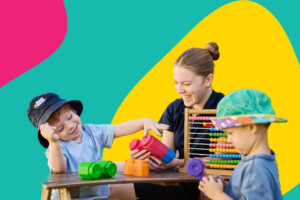
For example, while children are playing with blocks and loose parts, the educator can pose questions such as ‘What can you build?’ or ‘What do you think would happen if we took this piece away?’
It’s one of the key reasons why play-based learning is an important part of the Busy Bees curriculum. Our programs strike a careful balance between freedom and guidance, ensuring children feel supported while still having the space to learn in their own way.
Providing the Best of Play-Based Learning at Busy Bees
At Busy Bees, our learning environments are designed to stimulate and engage children’s natural curiosity and sense of discovery.
Our qualified educators work to understand how children learn best and use play-based approaches to support each child’s development. Experiences are tailored to children’s interests, creating inviting and engaging spaces that encourage learning through discovery.
With centres located across the country, Busy Bees provides high-quality childcare that prioritises development through meaningful learning experiences.
Ready to see play-based learning in action? Find a centre near you and book a tour today.
FAQs
What are different examples of play-based learning in early childhood?
Play-based learning can take many forms, each supporting a different area of development. Below are a range of different types of play that are used in early childhood.
- Sensory: Engaging the senses by playing with water, sand or other textured surfaces.
- Imaginative: Imaginative play builds creativity and social skills through storytelling.
- Physical: Movement-based activities support strength and coordination.
- Constructive: Sessions where children build structures or creations using blocks and materials.
- Active: Activities that support physical health through active play.
- Explorative: Experimenting with natural materials in childcare allows children to experience the benefits of nature play.
What is the difference between play-based learning and free play?
Free play removes guidance or structure, allowing children to choose what activities they complete.
Play-based learning, on the other hand, is a guided activity where educators support children by introducing ideas and asking questions. These experiences help children develop particular skills while they play.
Is play-based learning more important than direct instruction?
Play-based learning is especially important in the early years, as it fosters the development of young children through exploration, curiosity and interaction. By contrast, direct instruction supports specific skills as children grow.
While both have their place in early childhood education, it is play-based learning that builds a stronger foundation of confidence and creativity that children carry with them into school and beyond.
How can I adopt play-based learning at home?
Bringing play-based learning into your home is easy to do and very rewarding. You might consider setting up play spaces with open-ended toys and materials or encouraging imaginative play through dress-ups or storytelling. If you can, include sensory activities like water play, playdough and puzzles. And if you can’t, simply spending time outdoors exploring the backyard with your child can sometimes be enough to spark their imagination.